




The Civil Engineering Department’s laboratories constitute an advanced educational and research infrastructure, allowing students and researchers to gain practical experience, conduct experiments, and test materials and engineering systems, while connecting theoretical knowledge with professional application.
Dynamics of Structures Laboratory
The laboratory in the Dynamics of Structures course is designed to provide students with practical insight into the dynamic behavior of structural systems under time-varying loads. Within the laboratory, fundamental principles of single-degree-of-freedom and multi-degree-of-freedom system dynamics are studied and applied, integrating theoretical modelling, experimental measurements, and result analysis.
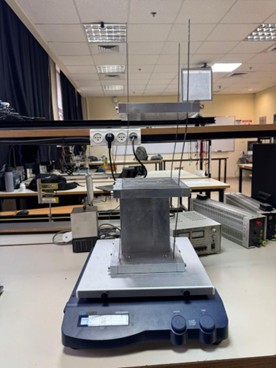
The response of a two-story structure is controlled by base displacement.
Each story is supported by four columns, and the floors diaphragms are assumed
to be rigid in-plane.
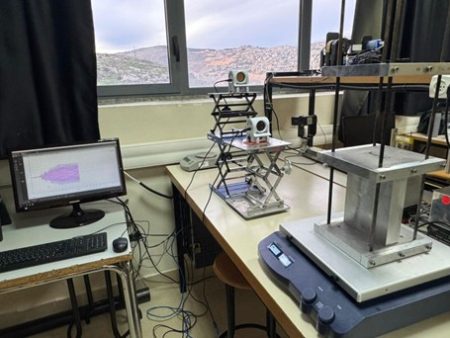
A data acquisition system is employed for the multi-degree-of-freedom (MDOF) structure.
A displacement sensor is installed on each floor, and the measured responses are displayed
in real time through the data acquisition interface.
Strength of Materials Laboratory
The laboratory course in Strength of Materials and Structural Statics focuses on practical experiments designed to illustrate and validate key theoretical principles. Students perform tests such as uniaxial tension, torsion, and beam bending to measure stress and deflections, as well as hardness and failure tests to examine material and structural behavior. Experiments on the determination of the center of mass and shear center highlight the effect of load position on structural response. Strain gauges are used to measure local and principal strains, and influence lines are studied using moving loads. Emphasis is placed on proper test planning, reliable measurements, data analysis, and comparison with theoretical engineering models, with the aim of developing experimental understanding and critical thinking.
Geomechanics Laboratory
The Geomechanics laboratory focuses on the experimental application of soil mechanics principles to understand soil behavior under different loading, moisture, and flow conditions. Students conduct soil classification tests, including sieve analysis and Atterberg limits; compaction tests to determine compaction curves, optimum moisture content, and maximum dry unit weight. The students measure hydraulic conductivity according to Darcy’s law. Flow nets are used to analyze steady-state flow and pore pressure distributions. Additional experiments include one-dimensional swelling tests on unsaturated clays and consolidation tests on saturated soils to investigate time-dependent settlements, effective stress principles, and key geotechnical parameters. Throughout the laboratory, emphasis is placed on proper specimen preparation, accurate measurement, result analysis, and comparison with theoretical models.
Introduction to building and paving materials
The laboratory specializes in the characterization and testing of civil engineering materials and mixtures. Our capabilities range from standard consistency testing (Vicat) and sieve analysis, to advanced instrumental techniques including X-Ray Diffraction (XRD) for mineralogical analysis and Ultrasonic Testing (using Ultratest equipment) for non-destructive evaluation. Additionally, the laboratory conducts corrosion assessments and analyzes material durability under various climatic and environmental conditions. These activities support academic research, teaching, and engineering quality control.