




Biomechanics Laboratories - Where mechanical engineering meets the human body
Our laboratories develop engineering solutions for human movement, rehabilitation, and assistive technologies, offering students hands-on experience through advanced measurement systems and real-world collaborations with hospitals, rehabilitation centers, and elite disabled athletes.
Overview
The Biomechanics Laboratories (Rooms 101–102) support teaching, research, and engineering development at the interface of mechanical engineering, medicine, and rehabilitation.
The laboratories focus on applying engineering tools and methods to the analysis of human movement and physiological systems, with a particular emphasis on assistive and rehabilitation technologies.
The laboratories serve undergraduate and graduate students through courses, capstone projects, honors projects, and flagship departmental initiatives, while also hosting collaborative research with hospitals, rehabilitation centers, and external research partners.
Research and Development Activities
Research conducted in the laboratories addresses both fundamental biomechanics and applied, real-world challenges, including:
- Development of systems for reducing hand tremor
- Assistive musical technologies for people with disabilities
- Cognitive-motor interaction during motor task performance
- Movement rehabilitation using Virtual Reality (VR)
- Brain-Computer Interfaces (BCIs)
- Experimental research on biological tissues and soft materials
- EEG hyper scanning: study of neural inter-brain patterns
- Fall prevention and Obstacle Negotiation
In parallel, the laboratories are actively involved in applied engineering projects, such as:
- Development of assistive and performance-support technologies for the Paralympic team
- Collaborative projects with hospitals and rehabilitation centers
- Engineering solutions for IDF veterans and injured soldiers
- Multidisciplinary research integrating engineers, clinicians, therapists, and researchers
These projects expose students to authentic engineering problems with significant social, clinical, and technological impact.
Measurement Systems and Experimental Infrastructure
The laboratories are equipped with advanced systems for monitoring kinematic, kinetic, and physiological aspects of human movement, during daily activities and while using assistive devices.
Available equipment includes:
- Force plates for ground reaction force analysis
- Plantar pressure measurement systems
- Instrumented gloves for hand force mapping
- Instrumented walkways for gait analysis
- Optical motion capture systems
- EEG and EMG systems
- Goniometers
- Digital graphic tablets
- Eye-tracking systems
- Physiological monitoring systems for Heart Rate Variability (HRV) and Electrodermal Activity (EDA)
- APDM (inertial-sensor–based systems for Gait analysis)
The laboratories also include a wide range of rehabilitation and assistive devices, such as wheelchairs, walkers, orthoses, and custom-built systems.
Prototyping and Advanced Manufacturing
To support the full engineering development cycle, the laboratories provide:
- Anatomical models of the human body
- Raw materials for prototype development
- 3D printing capabilities, including bioprinting of biological materials
- Traditional workshop with lathe and milling machine
These facilities enable students and researchers to progress from conceptual design to prototype fabrication and experimental validation.
Teaching and Academic Activity
Biomechanics Laboratories play a central role in departmental teaching.
Students gain hands-on experience in data acquisition, signal processing, and engineering analysis of biomechanical systems.
Projects conducted in the laboratories include:
- Capstone (final-year) projects
- Flagship departmental projects
Measurement systems are used for prototype validation, initial data collection, and engineering requirement definition, often in collaboration with external partners.
Courses Conducted in the Laboratories
- Rehabilitation Biomechanics
- Introduction to Biomechanics
- Designing Solutions to Surgical Problems
- The Human Body as an Engineering System
- Engineering Analysis of Physiological Systems
Why Students Should Join This Lab
Students who join the Biomechanics Laboratories benefit from:
- Hands-on experience with advanced measurement systems used in research, medicine, and industry
- Exposure to real-world engineering challenges in healthcare, rehabilitation, and human performance
- Opportunities to work on projects with direct social and clinical impact
- Experience in multidisciplinary teamwork, combining engineering with medicine and physiology
- Participation in collaborations with hospitals, rehabilitation centers, and elite disabled athletes
- Strong preparation for industry positions, advanced studies, and research careers
The laboratories provide a unique environment where students can apply mechanical engineering principles to meaningful human-centered problems.
Collaboration and External Partnerships
The Biomechanics Laboratories actively collaborate with:
Academic institutions: Haifa University, Pittsburg University USA
Hospitals: Poria Hospital, Ziv Hospital, Galilee Medical Center, Alyn Hospital
Rehabilitation centers: Reut TLV rehabilitation Hospital, Poria rehabilitation hospital
Nonprofit organizations: Elwyn Israel, AKIM Biet Gil, Kishorit, Sarav Protected Workshop, Karmiel – Rehabilitation of People with Mental Health Disabilities, Ma’arag Community Center, Kfar Vradim, Ecommunity, Migdal Or
Industry partners: Shapira Smart Solutions LTD
Philanthropic organizations: The Zimmer Foundation, ICA in Israel
We welcome joint research initiatives, clinical studies, technology development projects, and partnerships aimed at advancing rehabilitation engineering and assistive technologies.
Strength and Materials Laboratory
General
Strength and Materials Laboratory provides the students with hands-on experience, skills, and experimental validation of various theories in Solid Mechanics and Materials Engineering courses, as well as some acquaintance with measurement techniques and devices. The experiments and demonstrations delivered in the laboratory refer to three major branches, namely strength of materials, metallurgy, and measurement.
Strength of Materials
Stress-strain behavior of steels and aluminum alloys is studied in the laboratory by means of tensile tests. Tensile stress-stain tests conducted by using the computerized tensile test machine shown below demonstrate basic terms such as yield stress, UTS, Young’s modulus, elongation to fracture, and reduction of area. Hardness tests conducted on different metallic alloys, ferrous and non-ferrous, by means of a hardness tester require using different hardness scales, loads, and indenters. The advantages and the drawbacks of Rockwell A, Rockwell C, and Brinell scales are well presented. Various sets of strain gauges and Wheatstone bridge systems serve for measuring bending stresses and strains of loaded beams, for calculating principal stresses and principal directions, and for estimating the stress concentration in the case of a given geometrical constraint. Besides studying the mentioned phenomena, the students gain practice with tensometry resistance techniques and their different industrial applications.
Metallurgy
Special emphasis is given to metallurgy; three kinds of processes are investigated by the students in the laboratory. These processes are quenching of carbon steel, solution and aging of aluminum alloys. Metallographic specimens of the thermally treated alloys are prepared by the students for metallographic study. Images of the high temperature oven used for austenitizing and solution treatments, of the low temperature oven used for aging and of the optical microscope are shown below.
Measurement
The Strength and Materials Laboratory is well equipped with various measuring devices such as manual measuring tools (calipers, micrometers, protractors, gage blocks), optical profile projector and a computerized coordinate measuring machine.
Machining Processes Laboratory
The laboratory for research in metal machining is located in building D2. The lab was donated by ISCAR Ltd. – a world leader in producer of unique and innovative cutting tools for metalworking, including turning, grooving, milling, hole-making, boring and threading tools. It is a multinational company with representation in 50 countries.
The laboratory provides the students the essential hands-on training with modern machines and equipment, complementing their theoretical studies, and serves for research by the academic staff.
Machining is a key technology for industries in aerospace, die and mold, automotive, defense etc.
Industry 4.0 Demonstrator Lab
Lab Overview
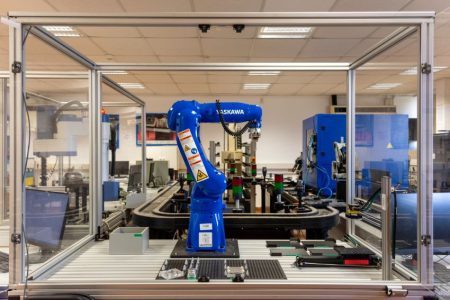
Our Industry 4.0 Demonstrator Lab brings the future of manufacturing to life. This dynamic facility serves as a hub for innovation, research, and hands-on learning, where students and researchers explore cutting-edge advancements in Industry 4.0 (I4.0) technologies. Located at Braude College Karmiel, our lab is at the forefront of the Fourth Industrial Revolution.
Lab Mission
The lab provides students and researchers with practical experience in I4.0 technologies through a fully operational mini-CIM (Computer Integrated Manufacturing) system. We bridge the gap between theoretical knowledge and real-world industrial applications, preparing students for careers in modern manufacturing and technology sectors.
Key Features
Our lab infrastructure includes:
- Mini-CIM Manufacturing System with multiple integrated stations: manager station, storage, CNC machining, quality assurance (QA), assembly, and human-machine interaction
- Material Handling Systems: Products and parts transported via conveyor belt and autonomous robots
- Robotics and Autonomous Robotics Systems
- Computer Vision Technologies
- IIoT (Industrial Internet of Things) Environment
- Advanced video conferencing capabilities with multiple cameras, enabling international collaborative learning and remote courses
Courses and Projects
The lab supports multiple academic programs across disciplines:
- Industrial Engineering: Introduction to CIM (Computer Integrated Manufacturing)
- Software Engineering: Virtual Reality (VR)
- Mechanical Engineering: Autonomous Robots, Computer Vision, Introduction to I4.0, Introduction to IoT
Learning Topics and Skills
Students engage with diverse I4.0 technologies including Virtual Reality (VR), autonomous robotics, computer vision, IIoT, and cyber-physical systems. Through hands-on experimentation, they develop technical skills in system integration, automation, manufacturing processes, and smart factory operations.
Research Activities
Current research projects in the lab focus on:
- Human-Machine Interaction
- Cyber-Physical Systems
- Autonomous Robotics
- Computer Vision Applications
The lab’s unique video infrastructure makes it the first facility at Braude College capable of hosting international video-based courses and collaborative research projects with partner institutions worldwide.
Mechatronics Teaching Laboratory
Overview
The Mechatronics Teaching Laboratory serves as the primary educational facility for students specializing in mechatronics engineering. Our state-of-the-art lab provides hands-on learning environments where theoretical concepts come to life through practical experimentation and system design.
Laboratory Courses
The facility supports the complete mechatronics curriculum, hosting three core courses that progressively develop students’ skills from foundational concepts to advanced system design:
- Introduction to Mechatronic Systems
This foundational course introduces students to the interdisciplinary nature of mechatronics, combining mechanical, electrical, and computer engineering principles.
Laboratory Facilities:- Professional-grade measurement and instrumentation equipment
- Configurable maze environment for autonomous navigation experiments
- Dedicated robotics experimentation area featuring mobile robot platforms
- Hands-on stations for sensor integration and actuator control
Students gain practical experience in system integration, sensor applications, and basic control algorithms while working with mobile robotic platforms.
- Mechatronics/ Control Laboratory
Building on foundational knowledge, this intermediate course focuses on control theory applications and system analysis.
Laboratory Facilities:- Advanced control systems experimentation equipment
- Modern data acquisition and analysis tools
- Real-time control implementation platforms
- Industry-standard software for modeling and simulation
Students conduct comprehensive experiments exploring classical and modern control techniques, system identification, and performance analysis of dynamic systems.
- Integrated Systems Design and Modern Control
This capstone laboratory course challenges students to apply advanced control design methodologies to complex mechatronic systems.
Laboratory Facilities:- Rotary inverted pendulum systems for nonlinear control studies
- Controller design and implementation workstations
- Real-time testing and validation equipment
- Advanced stabilization and trajectory control platforms
Students design, implement, and validate sophisticated controllers for the rotary inverted pendulum – a classical benchmark system that demonstrates advanced concepts in stabilization, balancing, and modern control theory.
Learning Outcomes
Through these progressive laboratory experiences, students develop:
- Practical skills in mechatronic system design and integration
- Proficiency with industry-standard tools and equipment
- Problem-solving abilities for complex control challenges
- Hands-on experience bridging theory and real-world applications
Robotics/ Mechatronics Research Laboratory
Overview
The Robotics/Mechatronics Research Laboratory serves as a dedicated innovation space for both faculty and students in the department. This facility provides an advanced environment for developing cutting-edge robotics and mechatronics systems, serving as an extension of the secondary teaching area in the Mechatronics Laboratory. The lab bridges the gap between classroom learning and real-world research, enabling the development and refinement of novel robotic platforms and mechatronic solutions.
Laboratory Infrastructure
The research laboratory is equipped with comprehensive infrastructure to support all stages of prototype development, from initial concept to fully functional systems.
Core Facilities
Workstations and Computing:
- Multiple dedicated computer workstations for design, simulation, and programming
- Software development environments for robotics and control systems
Prototyping and Assembly:
- Professional-grade hand tools and power tools
- Electronics workbenches with measurement and testing equipment
- Multiple soldering stations for circuit assembly and prototyping
- Component storage and organization systems
Essential Utilities:
- Electrical power distribution throughout the workspace
- Wireless network infrastructure for connectivity and remote operations
- Compressed air supply for pneumatic systems and cleaning
Collaborative Robotics Platform
The laboratory features a Universal Robots UR10e collaborative robot (cobot), which serves dual purposes:
- Research applications: Platform for advanced robotics research, human-robot interaction studies, and automation development
- Educational demonstrations: Hands-on teaching tool for robotics courses and student training
Research Projects
The laboratory hosts diverse research and development projects, with equipment and consumables continuously adapted to meet current project requirements. Notable platforms developed and maintained in the laboratory include:
Dynamic Mimicking Platform – Wheelchair assistive robotics platform
RoBraude – Mobile robot
Miniature Jumping Robot – Micro-scale robotic platform with jumping locomotion
Smart Gripper – Adaptive robotic end-effector
and many other innovative systems currently under development.
Dynamic Research Environment
The laboratory operates as a flexible research space where:
- Equipment inventory adapts to ongoing project needs
- Both permanent infrastructure and consumable materials evolve with research directions
- Students and faculty collaborate on prototype development and testing
- Theoretical concepts are validated through hands-on implementation
Supporting Innovation
This facility enables researchers and students to:
- Transform conceptual designs into working prototypes
- Conduct experiments with novel robotic systems
- Iterate rapidly on mechatronic designs
- Develop practical skills in system integration and fabrication
- Bridge academic research with practical engineering challenges
Machining Laboratory
Summary of Skills and Expertise Gained in the Machining Laboratory
In the machining laboratory, students develop strong foundational skills in both manual machining operations and precision measurement. Through hands on practice, they learn how to safely operate essential machine tools such as drilling machines, lathes for turning operations, and milling or other machining equipment. Students gain practical experience in setting up workpieces, selecting proper cutting tools, adjusting machine parameters, and producing components to specified dimensions.
A key part of the training involves mastering precision measuring instruments, including calipers, micrometers, gauges, and other metrology tools. Students learn how to accurately inspect machined parts, interpret technical drawings, and ensure dimensional accuracy and surface quality.
By the end of the course, students demonstrate competency in:
- Drilling, turning, and machining operations
- Workpiece setup, tool selection, and machine adjustments
- Safe operation of machine tools and adherence to lab safety protocols
- Use of precision measuring tools (e.g., calipers, micrometers)
- Quality control, tolerance measurement, and part inspection
- Understanding manufacturing processes and interpreting engineering drawings
This combination of practical machining skills and precision measurement knowledge prepares students for advanced manufacturing, mechanical engineering applications, and real world industrial environments.
Transient processes laboratory
This laboratory constitutes a central component in the training of students in the field of Mechanical Engineering, providing hands-on experience with the principles taught in the courses Fluid Mechanics and Heat Transfer. The laboratory serves as an essential bridge between the theoretical knowledge acquired in the classroom and its application in practical engineering contexts.
Throughout the laboratory work, students acquire a range of skills that are essential for professional engineering practice. They gain experience in operating experimental systems and, at times, in troubleshooting technical malfunctions in real time. In addition, students learn to use a variety of measurement instruments and to cope with measurement uncertainties. Successful completion of the course requires the ability to process and analyze experimental data, compare results with theoretical predictions, and draw sound conclusions. Students also develop technical writing skills through the preparation of comprehensive laboratory reports that address all aspects of the experiments.
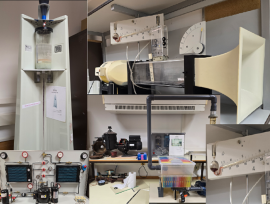
The figure illustrates some of the laboratory setups used in various experiments in the fields of fluid mechanics and heat transfer
The laboratory content is divided into two main parts. The larger portion focuses on experiments in fluid mechanics. In this part, students learn to work with a Venturi tube and perform experiments based on Bernoulli’s equation, both neglecting losses and accounting for them, including the measurement of flow losses in various flow devices. They also conduct a Reynolds experiment to demonstrate the transition to turbulent flow, perform a hydrostatics experiment, and carry out wind tunnel experiments in which drag and lift forces are measured.
The second part of the laboratory addresses heat transfer and is intended to reinforce the material taught in the course of the same name. The experiments demonstrate the three fundamental modes of heat transfer—conduction, convection, and radiation. In addition, the laboratory includes a heat exchanger in which the flow direction can be reversed, allowing temperature measurements at various locations throughout the system.